
Technology
The AEROGRID® system
Zero-rotary aerofoil oscillation + solar energy with integrated sun tracking. Patented hexagonal ducted panels harvest turbulent ground-wind through rapid aerofoil oscillation. Gusts of 4 m/s are abundant across ~80% of the globe.
Mechanism
No rotating components
Rather than a rotor swept by steady high-altitude laminar wind, AEROGRID uses aerofoils that oscillate rapidly in response to turbulent gusts at ground level — the wind that exists almost everywhere.
- No rotating components — oscillating aerofoils
- Modular panels — urban, highway, airport, industrial, communities, almost anywhere
- 25+ year service and warrantied lifespan
- Daily sun tracking boosts solar up to 30%

The Hex Unit is the platform’s building block. Roughly 40 Hex Units make up a 100kW array, producing 400MWh/yr per year of 24-hour usable electricity, with six independent power generation ducts that can be serviced individually without powering down the array.
Anatomy
Take it apart. Build it up.
Four parts make a Hex Unit; twelve Hex Units make a 32 kW array; thirty-three arrays make the megawatt block every number on this page is priced on.
Hover or tap a number
01
Oscillating aerofoils
Aerofoils that flutter rapidly in turbulent gusts instead of rotating. They respond to changes in wind speed and direction within a second — the reason 2.4 m/s is enough to start generating.
1
Hex Unit
The building block. Roughly 40 make a 100 kW array.
12
Hex Units
One 32 kW array with a sun-tracking solar canopy on top.
33
Arrays
The 1 MW installation the LCOE table is priced on — 1,800 m² of land.
Configuration
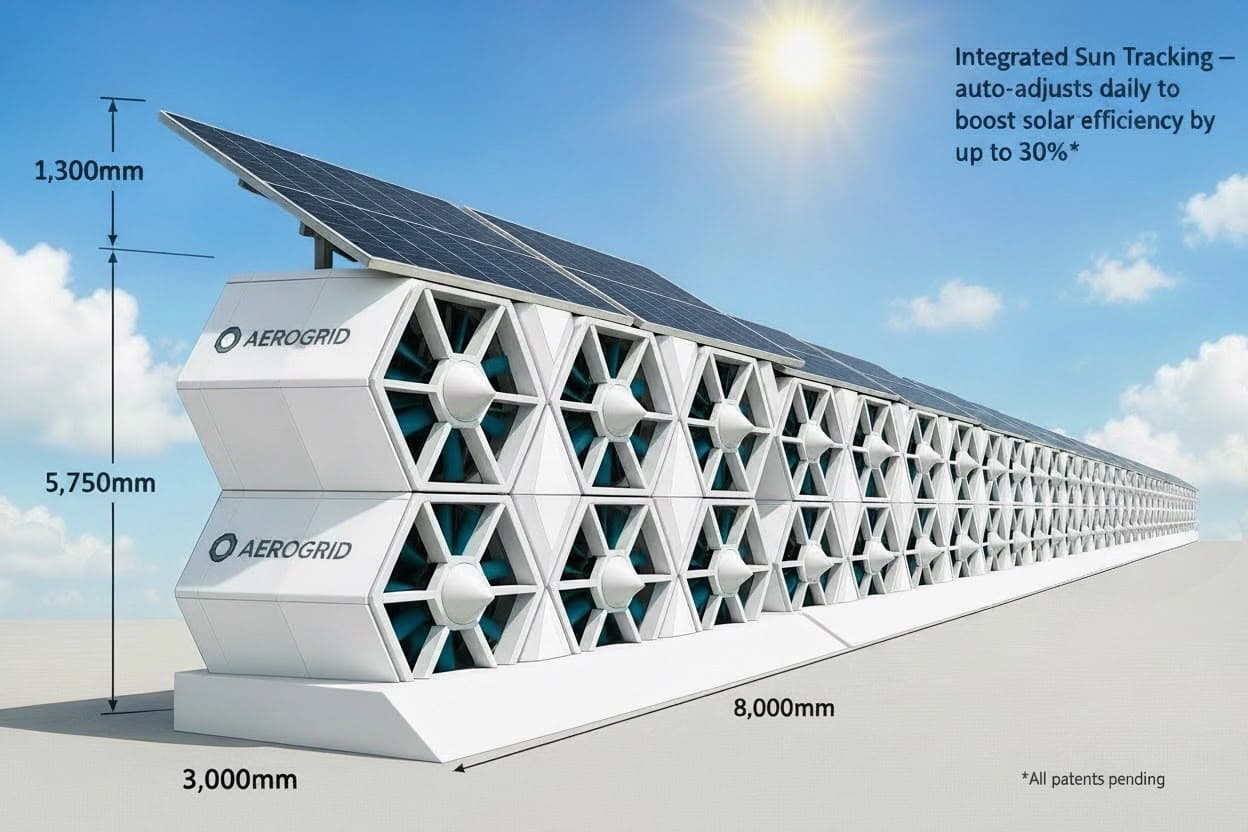
Example: 100kW Wind-Solar Hybrid Array
Footprint: 60m L × 3m W × 7m H. Integrated sun tracking auto-adjusts daily to boost solar efficiency by up to 30%.
$0.08/kWh
Targeted LCOE
$0.07 at MW scale
24/7
Generation window
Wind 24/7, day and night, with daily solar and battery backup
25year
Hands-free service warranty
Auto-renews compounding annually
4×
Energy density
vs. solar panels by area
AEROGRID vs Solar
AEROGRID produces 4.3GWh per year from our 1MW installation on one quarter of the footprint; whereas solar can only produce 2.8GWh per year with a 4× bigger footprint — making AEROGRID 4× denser and 54% more productive than solar.
Economics
1MW install — AEROGRID vs solar
Levelised cost, capital, annual performance and land efficiency for a 1MW installation over 25 years.
| Metric | AEROGRID Hybrid (32kW Arrays × 33) | Solar Panels (23% eff, mono) |
|---|---|---|
| 25-Year Economics (1MW) | ||
| 25-Year Energy (with deg. — kWh) | 107,936,340 | 57,458,469 |
| 25-Year Total Cost | $8,795,947 | $3,081,986 |
| LCOE ($/kWh) incl. battery 2× repl | $0.08 | $0.10 |
| Capital Cost | ||
| Nameplate Capacity 1MW | 32kW AEROGRID × 33 | 665W × 1503 Flat Panels |
| Unit / Panel / Gridwall Kit PPA owner | $2,531,858 | $270,540 |
| Battery Pack ~ Full Cap. Operation | $336,538 | $1,405,540 |
| Electronics / PCS | $35,880 | $81,162 |
| Structure / Mounting | $192,000 | $121,743 |
| Installation Labour | $126,593 | $75,751 |
| Total Installed Cost | $3,222,870 | $1,954,736 |
| Annual Performance | ||
| CUF (Cap. Utilization Factor) | 75% Wind / 33% Solar | 29% |
| Annual Energy Output (kWh) | 4,317,454 | 2,872,923 |
| Daily Energy Output (kWh) | 11,829 | 7,871 |
| Peak Hours / Day (Solar) | 7 | 7 |
| Annual Operating Costs | ||
| Fuel / Maint Cost / Year | $490 | $30 |
| O&M Cost | 20 Hex × 20 arrays | $30/yr/panel |
| Major Overhauls | — | — |
| Annual OpEx Total | $196,000 | $45,090 |
| Land Efficiency | ||
| m² / MW | 1,800 | 5,000 |
| Energy Output kWh / year / m² | 2,399 | 575 |
| Land Efficiency / Solar Panels | 4.2 | 1.0 |
Size your site
What would your land produce?
Pick a strip of land you already have and your local power price. The 1 MW Commercial Validation model scales to it.
Indicative only. Scaled linearly from the 1 MW Commercial Validation model (1,800 m²/MW, 4.32 GWh/yr, $0.08/kWh). Real yields depend on the site's wind profile — that is what a Commercial Validation assessment measures.
AEROGRID capacity
16.7MW
550 × 32 kW arrays
Annual generation
72GWh / yr
vs. 17 GWh / yr from solar on the same land
Powers the equivalent of
7,196homes
or 206 AI server racks running 24/7
Solar would need
13ha
for the same output — 4.2× the land
Annual saving vs. grid
$5.0M
AEROGRID LCOE $0.08/kWh against your $0.15/kWh
Indicative payback
5.0years
on $54M installed, at your grid price
Problem & solution
Why existing renewables leave energy on the table
The problem
Traditional renewable solutions face significant limitations:
- Conventional wind systems cannot economically capture turbulent ground-level gusts.
- Solar generation stops at night and requires expensive battery storage for 24/7 operation.
- Large renewable installations require substantial land and infrastructure investment.
- Grid operators and customers seek more stable, predictable renewable generation profiles.
The AEROGRID solution
AEROGRID combines:
- Patented oscillating aerofoil wind technology
- Integrated solar generation with daily solar tracking
- Hydraulic energy buffering and grid-friendly power conversion
- Modular, scalable architecture for urban, industrial, transportation, and utility applications
The result is a renewable energy platform capable of harvesting both wind and solar resources while delivering 24-hour generation profile.
The measurement gap
The world has been measuring the wrong wind
Conventional wind relied on MET data averaged over long intervals — a smooth profile that hides the real energy in ground-level turbulent gusts.
What MET data shows
- 1-hour averages flatten gust energy
- Smooth profiles look commercially weak
- Devices designed for the wrong wind
What was missed
- Ground-level turbulent gust energy
- Vortex paths and micro-events
- Abundant usable wind in populated regions
MET data · 1-hour average
0.00kWh so far
What the averaged data would have you believe
Katrick · 1-second sampling
0.00kWh so far
What the turbulence actually delivers
—
more energy in the same wind
Programme footprint
Where AEROGRID is being validated and deployed
One validation center, one technology base, and Showcase territories on three continents — all on the ground-level wind that is routine across most of the populated world.
~80%of the globe sees routine 4 m/s ground-level gusts
Case study
Advancing Green Airports
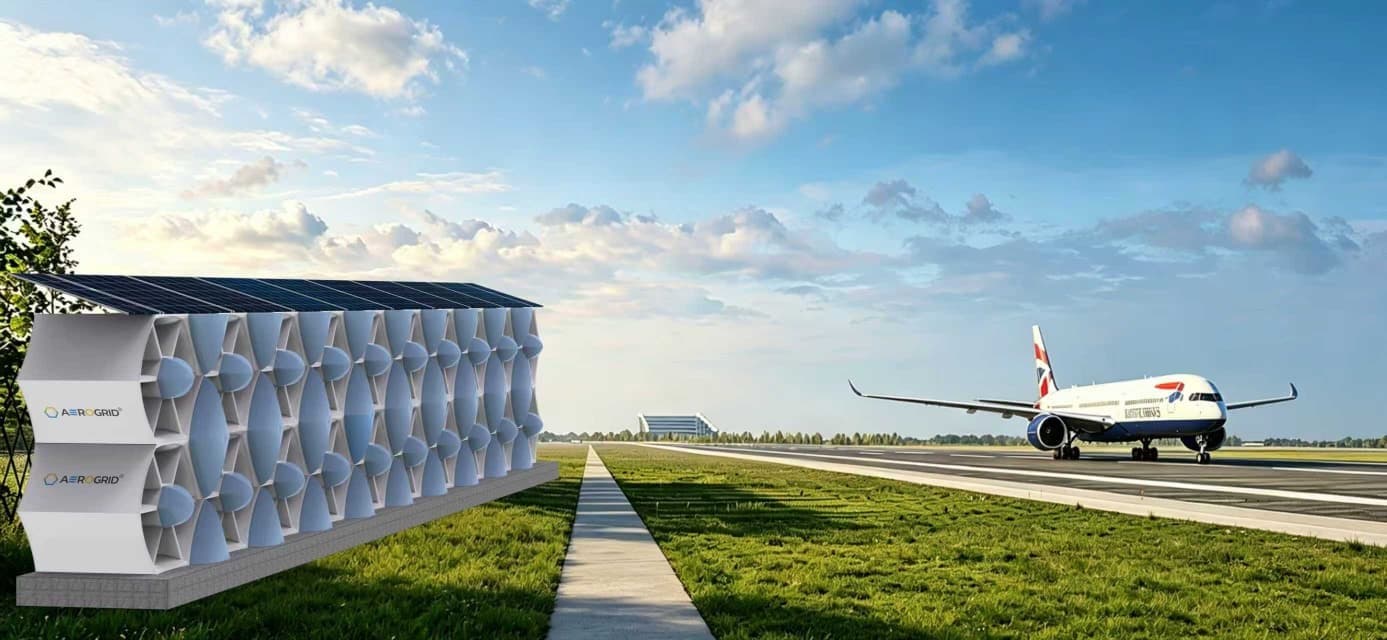
Airports sit on exactly the wind AEROGRID is built for — open, unobstructed ground where turbulent low-level gusts run all day beside land that is already in operational use.
Our case study examines onsite low-level wind energy generation at Edinburgh Airport: the resource available at ground level, how it maps onto airside land, and what onsite generation means for an operator working toward net zero.
Read the case studyOpens as a PDF in a new tab.
Deployment
From concrete pad to generation
Your AEROGRID array moves through a defined proprietary installation sequence, creating immidiate local service revenue across the 25-year asset life.
- 01
Vanguard agreement locked + $500k deposit on MW+ MOU for 2027
- 02
Site prep for AREOGRID showcase Array (concrete pad)
- 03
Erect grid wall with AEROGRID owner (CP + local team appointed)
- 04
Install ducts, aerofoils, solar & tracker system
- 05
Install and connect hydraulic & electrical systems
- 06
Begin generation — 400 MWh/yr (100 kWp)
- 07
Local service model for 25-year lifespan